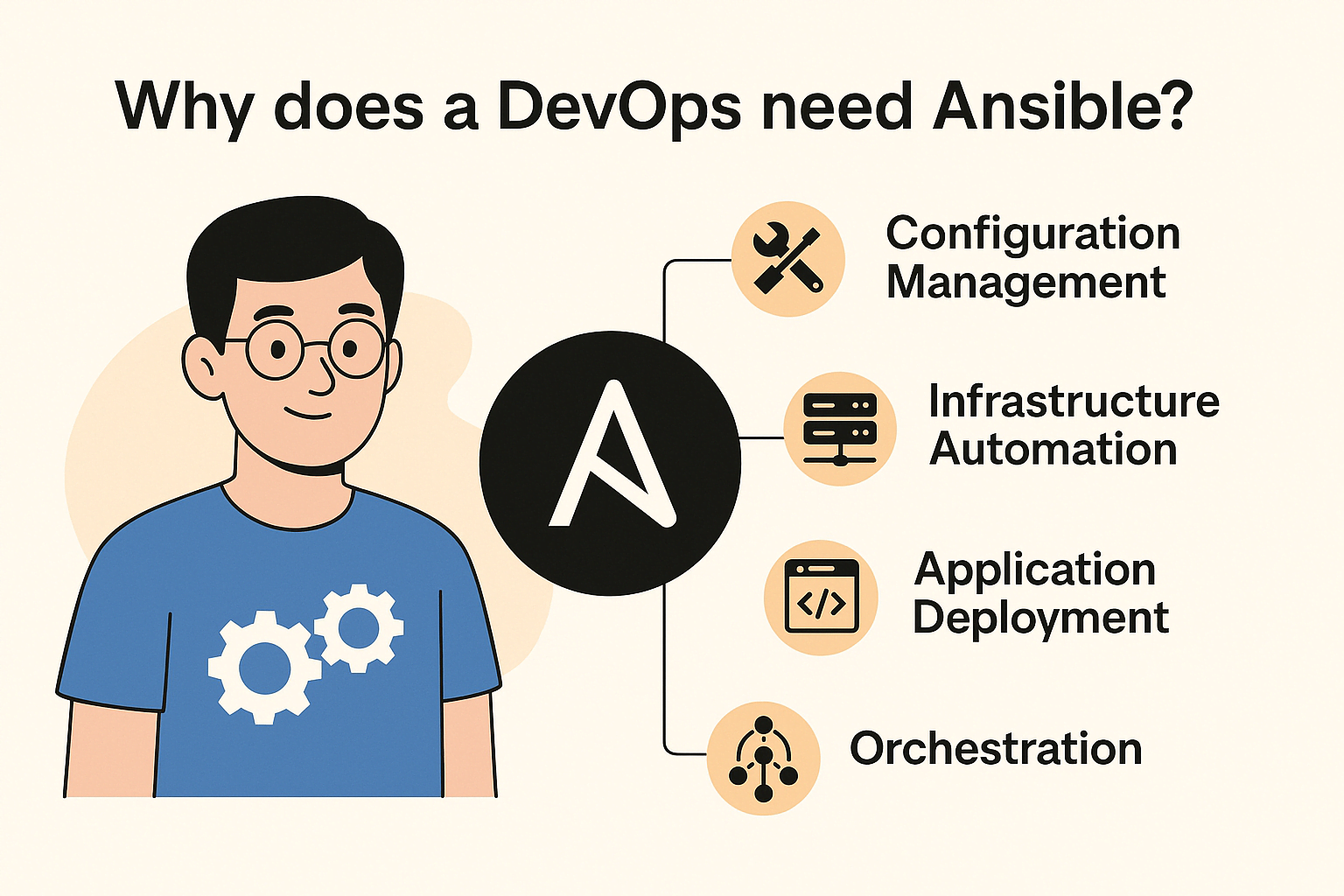
The Core Purpose of Ansible
Ansible is primarily a configuration management and infrastructure automation tool. You use Ansible when you want to define and enforce the desired state of systems, repeatably and reliably — often across many servers at once.
✅ Common Use Cases for Ansible
- Server Configuration and Provisioning
- Application Deployment
- Infrastructure as Code (IaC) – Light-weight
- Repetitive Admin Tasks
- Security Hardening and Compliance
What Does "Configuration Management & Infrastructure Automation" Mean?
🎯 Step 1: Imagine You Just Got 10 New Servers
You’re working for a company. Your boss says:
“Joy, we need to prepare these 10 servers so they’re ready to host our Django app.” If you had to do it manually, you'd:
- SSH into each server
- Install Python, Nginx, Git, PostgreSQL
- Set up users, permissions
- Configure firewalls
- Clone your repo
- Set environment variables
❌ Problem: It’s repetitive, time-consuming, error-prone, and hard to reproduce.
Configuration Management: Define What Each Server Should Look Like
- name: Set up web server
  hosts: web_servers
  become: true
  tasks:

    - name: Install Nginx
      apt:
        name: nginx
        state: present

    - name: Ensure Nginx is running
      service:
        name: nginx
        state: started
        enabled: true
Infrastructure Automation: Do It Automatically, and at Scale
bash ansible-playbook setup_web_server.yml -i inventory.ini
And boom! Ansible logs into all 10 servers, does the setup in parallel, and shows a nice report of what changed.
🧑💻 Real-Life Scenario: From Manual Chaos to Clean Automation
🏢 Scenario: You’re a Junior DevOps Engineer at a Startup
Your team wants to:
- Deploy a Django app
- Use PostgreSQL
- Use Gunicorn + Nginx as a reverse proxy
- Set this up on 3 servers: web, db, and worker
Without Ansible:
- You’d SSH and manually install packages and configs
- You’d forget one command and spend hours debugging
- It’s not scalable when you get 10 more servers
With Ansible:
- You write 3 playbooks (or roles): web.yml, db.yml, worker.yml
- You define everything in code: packages, users, files, services
- You run them with one command
This is configuration management (ensuring consistent setup) + automation (doing it at scale, hands-free).